Hello readers! Welcome to another blog post!
As a mom to a child on the spectrum who loves to be on the go, I’ve learned that navigating playdates and social settings can be challenging but also rewarding. My son is fearless and full of energy, that’s part of what makes him who he is- but it’s not always easy connecting with others. Whether a casual playdate or a social setting often there are challenges. Over time I have learned that understanding my son’s individual needs, preparing for social situations, and learning to manage my expectations are key to making playdates and social settings enjoyable. For this week’s post, I will share tips, insights, and stories from our journey of helping my child thrive in social settings.
Understanding Your Child’s Comfort Zone
Before diving into social settings or planning playdates one thing to remember: every kid on the spectrum has a unique comfort zone. Understanding where your child feels safe, comfortable, and centered is the key to any successful playdate/social experience! Some little ones love being around other kids but might only feel comfortable watching from the sidelines at first. Others might prefer quiet, familiar spaces and get overwhelmed in loud or busy settings. Just watch how your child reacts- do they seem calm or anxious? Do they need breaks or do better with one-on-one play? Seriously, keeping these questions in mind can make planning playdates so much easier.
Our son enjoys the high energy of group play, and we’ve discovered that he thrives in settings like bounce houses and parks. We first realized this at a birthday party he was invited to at a local bounce house. Honestly, I was hesitant at first- I wasn’t sure how he’d respond to the crowd, noise, and all the stimulation. But to my surprise, it became one of our first truly successful play dates. He was engaged, happy, and completely in his element. That experience reminded me how important it is to stay open to new possibilities- even when they feel uncertain- and to notice where our kids light up.
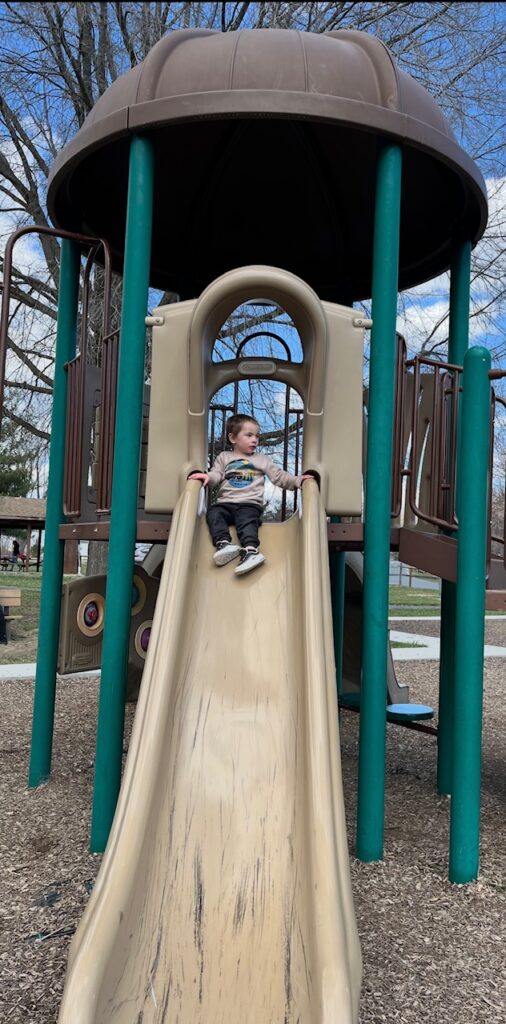
One of the biggest things I’ve learned as a mom is to differentiate, between when my child is enjoying himself and when things are starting to be too much. When he is thriving he is relaxed, flapping happily, and just doing his own thing with ease. He might not be directly playing with other kids, he is however content being around them. At the park, my son just runs back and forth, climbs the slide multiple times, and then heads straight for the swings. It’s the same at a bounce house- he’s always running around, completely in his element. But then, just recently at a bounce house, there was a bigger crowd than usual. He froze at the top of the slide and started crying, calling out, “Mama.” It was his way of communicating, “I need out.” It’s those little changes in behavior that have become my cues. Learning to read them has helped me to know when to lean in and when it’s time to part ways, and it’s made all the difference in helping my son feel safe and understood.
Prepping for Playdates
Prepping for playdates becomes this little ritual in our house. When prepping for playdates I’ve learned setting the stage ahead of time makes a difference. We talk about who we’re going to see, where we’re going, and what to expect. We do this using pictures or simple language depending on the day. Depending on where the playdate is located I will pack a small bag with comfort items and snacks just in case. If we are meeting up with another party I will try to give the other parent a heads up about what to expect- like how my kid might not want to share toys right away or that he’s happier playing side by side rather than directly with other kids. My intention is not to over-control the situation but to give my son a chance to enjoy the playdate on his terms.
During the Playdate
Once the playdate begins my role shifts from a planner to a guide. I try to stay nearby without hovering- and being his home base if he needs to check-in. Depending on the environment determines if he dives right in or if he hangs back and just observes, which I’ve come to realize is still participation for him. I keep an eye out for signs that he’s getting overstimulated- like if he elopes, covers his ears, or wants to be picked up and if that happens, we might take a quick sensory break or go somewhere quiet for a few minutes. I’ve also learned not to stress if things don’t go “perfectly”. Some playdates last longer than others and are full of laughter and shared moments, and others are short and sweet- and both are okay.
The Aftermath: Reflection and Recovery
After a playdate or social event, individuals on the spectrum need time to process and recover from the experience. The aftermath can be crucial, especially if the event was overwhelming and caused overstimulation. For many, social interactions can be draining, even if the event was enjoyable. The sensory input from a noisy environment, with the demands of socializing, can leave one feeling fatigued, anxious, or irritable. This is why it’s important to allow for a quiet recovery period afterward. Some may retreat to a safe space where they can engage in calming activities such as listening to music or playing with a sensory toy to help recharge.
During this time of recovery, reflection on the experience is key. It’s helpful to detect how your child felt during different moments of the playdate- what parts were enjoyable and which moments caused discomfort. Did certain social cues feel difficult to understand, or was there a particular interaction that felt uncomfortable? Processing these emotions can help better understand social needs and preferences.
This also presents an opportunity to develop coping strategies for future interactions. For example, if a certain noise level or crowd level is too much your child may learn to recognize when they need a break and communicate that to others. Similarly reflecting on what went well, can provide confidence for future social settings, reinforcing positive behaviors and social interactions. Ultimately the recovery process allows for emotional healing and growth, while also nurturing the development of important social skills for the future.
Navigating Social Invitations and Group Settings
When it comes to Social invitations and group settings, things can get a little tricky for us. At times, the invite sounds fun but all the unknowns- like who’s coming, how loud it might be, or how long it will last- can feel overwhelming. I’ve learned it’s okay to ask questions and set boundaries. Whether it’s texting ahead to find out the plan or bringing something comforting (like a favorite fidget), those little steps make a big difference. And honestly, it’s perfectly fine to leave early or skip an event altogether if it feels too much. Socializing isn’t a one-size-fits-all and that’s okay.
One of the hardest parts, honestly, has been managing my expectations and emotions around social experiences. I used to feel like every playdate or group outing needed to go “well” for it to be worth it- like it had to be a certain way. But the truth is, some days are harder than others, and that’s okay. I am learning to let go of perfection and embrace the small wins; a smile, a moment of connection, or just showing up. I am also learning that it is okay to feel disappointed sometimes- it doesn’t mean I’m failing. Giving myself space to feel, recompose myself, and try again with understanding has been just as important as anything else. I’m learning to give both my child and me grace.
Encouragement for other parents
To any parent walking this path, I am going to give you the same encouragement I receive and let you know you are doing an incredible job. It’s not always easy navigating uncharted territory. There are moments of doubt, exhaustion, and heartache. But there are also moments of joy, satisfaction, and connection that are indescribable. You are not alone in this, every small step your child takes is a reflection of your love, patience, and advocacy. Celebrate those tiny victories, lean on your community, take breaks when you need them, and trust that progress doesn’t have to be fast to be meaningful. Always remember you are exactly the parent your child needs.
At the end of the day, this journey isn’t about fitting into someone else’s idea or even your idea of what social success should look like- it’s about admiring our kids for who they are and walking alongside them with love. Some days are messy, some are smooth sailing, and most are in between. But every step matters, every moment of connection, every boundary respected, every time and we choose patience over pressure we’re having an impact. If you’re navigating this too, I see you, you’re not alone. Your child is blessed to have you in their corner!
Awesome https://urlr.me/zH3wE5
Very good https://rb.gy/4gq2o4